Twelfth Sunday in Ordinary Time

Dominica XII per Annum B
20 June 2021

Today’s brief Gospel passage from St. Mark shows us a miracle that demonstrates that Jesus is God.  The miracle of the Stilling or the Calming of the Storm shows us the identity of Jesus as God.  The passage concludes with the question of the disciples who are in awe at his power.  They ask: “Who then is this whom even wind and sea obey?”  That the passage ends with this question, I suggest, highlights it is a question for each of us, a question we must each face and answer.  Who is Jesus really?  Do I have faith that He is God?

First, we need to appreciate the context to grasp the significance of the miracle.  The setting is the Sea of Galilee.  The Sea of Galilee is a good-sized lake, about 7-8 miles wide at its widest.  More importantly, it is known to have sudden storms whip up.  Most of us know that it can be very soothing to be out on water when the water is peaceful.  But to be in a small boat when a storm whips up is very dangerous and terrifying.  We need to notice the words of the Gospel passage itself, which describes the storm as a “violent squall” with waves breaking over the boat such that the boat was filling up and in danger of sinking.  Added to this context is that we know the occupation of most of Jesus’ apostles who were with him.  They were fishermen and they knew the Sea of Galilee well.  That these experienced fishermen were terrified and convinced they were perishing gives us still more context to see just how serious and powerful a storm this was.  In a striking contrast to the details about the seriousness and the danger of the storm we have the description of Jesus asleep on a cushion through it all, taking his rest and undisturbed by a storm that the men in the boat with him knew could very well take their lives.  They cry out: “Teacher, do you not care that we are perishing?”  Jesus wakes up, and in an exorcistic response confronting evil, he rebukes the wind and he commands the sea, “Quiet! Be still!”

Today the first reading and the psalm selection together with this Gospel are all remarkably similar and place before us a clear theme and revelation of God’s identity and power.  Today’s psalm shows us sailors conducting their business on the sea in ships.  The psalm highlights the powerful works of God who made the sea and who controls it.  In the psalm a storm rises up with wind and waves that toss the ships about, such that the hearts of the sailors “melted away in their plight.”  In the psalm, the sailors cried to the Lord in their distress.  In the Gospel, the apostolic sailors cried out to Jesus.  In the psalm, the Lord rescued them by hushing the storm and stilling the waves.  In the Gospel, Jesus rebukes and commands the storm wind and waves.  By placing this exact psalm together with today’s Gospel selection, the Church is expressing her faith that this miracle demonstrates the divinity of Jesus.  Furthermore, combatting any pagan notion that Jesus is simply somehow one God among many, putting this Gospel together with this psalm identifies Jesus with the God of the Old Testament.  Jesus is the God who in the Old Testament calmed the storm and was sung about in Psalm 107.  Jesus shows this power in the miracle on the Sea of Galilee.

So, with this context helping us grasp the full threat of the storm and, thereby, the full manifestation of Jesus’ power as God in confronting it, I want to draw our attention to the question Jesus asks after waking up and snuffing out the storm.  He asks, “Why are you terrified?  Do you not yet have faith?”  The word used by Jesus and translated as “faith” can have a couple of important meanings and usages.  Both meanings are important to us as believers.  “Faith” can refer to the intellectual assent we must make to the truths of the faith.  So, for instance, we have recently celebrated liturgically in the past few weekends doctrines such as our belief that God is one God in Three Divine Persons, a Holy Trinity.  We have celebrated our faith that Jesus continues to be made present in the Holy Eucharist by which he remains with us and, when we are worthily prepared in a state of grace, we may participate in the Holy Eucharist by receiving that gift as divine food in Holy Communion.  But notice that the need for faith in the midst of the storm in today’s Gospel is not that meaning of the word that refers to intellectual assent.  In other words, the disciples are terrified and they call out; Jesus calms the storm, but he is not asking them an intellectual matter, as in “Why don’t you believe enough in the doctrine of the Trinity?”  He is not saying to them, “If only you would have recited the Creed.”  No, faith has another principal meaning here and it too needs our attention.  The question of Jesus after the storm is more about faith as trust, trust in God, trust in His power, trust in His working even when our limited human powers are threatened.

Over the years, I have had many interactions with people who might well identify with the image of serious storms in life.  It’s the story of Job from the first reading, a story that fits so well with the psalm and the Gospel message about storms.  Life will toss us about in its storms.  Like Job we may suffer terrible loss.  It would be foolish to think we will sail through this life without some serious turmoil and struggle, storms caused perhaps by others around us; storms caused perhaps by our own weakness, sinfulness, and poor choices; storms caused perhaps by defects in our character, emotional and psychological suffering, stuff internal to us that just is, even though we might not be guilty for choosing it… the list goes on.  Who is Jesus for you in such experiences of life?  Do you have faith – trust – in him?  Sometimes praying in our adoration chapel makes me consider how perfect an image it is for our passage through the sea of this life, an image of today’s Gospel.  Jesus is there displayed in our chapel.  He is still and quiet, almost as if sleeping on a cushion of the boat.  You and I come in there, into that “boat,” with all the stuff going on in our lives.  But he is with us!  Sometimes the sounds outside surrounding the chapel, especially in the daylight hours, remind me of that contrast of storm versus Jesus calmly asleep with full power.  I may be in that quiet chapel but internally I may bring much noise and storminess.  I may be in the quiet chapel but outside perhaps it is the voices of children playing on the playground, or the sounds of cars, or lawn mowers, or roofers… and don’t even get me started when someone flushes one of our toilets and it sounds like a rocket is taking off…  All this noise surrounds us, the storms surround us… distracting us… demanding our attention… but Jesus is with us quiet and still.  In preparing for this weekend’s homily I found myself wanting to encourage and to make a clear call to each of you to find time to dedicate to prayer in our chapel with Jesus who is really there.  Yes, we can and should pray anywhere, and especially in our homes.  But sometimes the journey to get up, to make a little pilgrimage, to leave our home, and to leave our busy activities, and get into the boat of our little chapel to be with Jesus in our storms is what is also needed.  I want to encourage you to make frequent visits to adore Jesus in the chapel.  I want to encourage you to contact the office and our adoration program to commit to a time of prayer in the chapel.  You won’t regret it!

When we come to the chapel with the external and internal storms of life, it seems to me we can powerfully live today’s Gospel passage.  We come there in the quiet and we might want to call out to wake Jesus up, “Don’t you care that I am perishing?”  The faith that is trust needs attention and needs to be exercised so that we come to experience Jesus who is God and who is the same God as in the Old Testament who calms the storm.  In the boat of the chapel we can’t pretend the storms of our lives aren’t circling around us.  Part of growing in that faith that is trust is learning to call out to God in our need and in the sometimes humiliating storms we can’t so easily control.  So often in life we both start and stop with only what our own power can accomplish.  Inspired by the revelation in today’s passages that Jesus is God, may we come to call out to the Lord.  Our calling out to him, our waking him up so to speak, just as in the Gospel, is the precursor to his powerful command: “Quiet!  Be still!”
Corpus Christi

Sollemnitas Corpus Christi
6 June 2021

 This annual Solemnity of the Most Holy Body and Blood of Christ (commonly called in Latin, Corpus Christi) is our opportunity to sharpen our focus so that we never take for granted that the Holy Eucharist is the Body and Blood, Soul and Divinity, of Jesus Christ.  For those of us who are here week after week, taking time to clearly state what the Holy Eucharist is and what it requires of us who desire to receive it may seem rather elementary.  However, we never want to take the faith for granted or assume we are immune to decreased faith.  The grind of daily life can weaken our faith too.  And in an age that greatly underplays what we owe to God and what we must observe to be eligible for receiving Holy Communion, it seems important to take some time to refresh our appreciation of this most august Sacrament.

More recently, following Joe Biden’s ascent to the Presidency, the topic of what is required to receive Holy Communion and what is meant by worthiness to present oneself for Holy Communion has been pushed into the spotlight.  Truthfully, the controversy over self-described “devout Catholic” politicians who consistently advocate policies at odds with grave matters of Catholic doctrine (like the promotion and advancement of abortion and same-sex marriage) is a controversy that has existed, sadly, for a long time.  When you also consider that we live in an age of slogans that are given the weight of moral imperative – slogans like “welcoming” and “inclusion” and “tolerance” – we need to keep our wits about us and not let sentimentality cause us to deviate from proper Eucharistic faith and practice.  I want to suggest that understanding eligibility for Holy Communion (a) stems from and supports our teaching and faith in what the Holy Eucharist is; (b) that it can be understood positively; and, (c) that it actually gives zeal to our evangelical and missionary impulse to work to bring others into Eucharistic communion.

First, let’s remind ourselves clearly of what the Holy Eucharist is: Given the many foreshadowings in the Bible indicating God’s feeding us with bread from Heaven, and given the climax of that promise at the Last Supper, we believe that Jesus transformed bread and wine into the substance of his Body and Blood.  We believe that he left this gift to his Church for nourishment and so that he would be always with us in his Real Presence.  We believe that he left us a means to have this sacrificial food provided to us by establishing his apostles as the first priests.  Having a validly ordained priesthood, which carries that shared authority from Christ, a valid priesthood that exists in the Catholic Church, we believe that at Holy Mass bread and wine are transformed into the Body, Blood, Soul, and Divinity of Christ.  This gift is not dead flesh, but the living, resurrected flesh of the Lord.  This gift comes about by the will of God the Father, by the power of God the Holy Spirit who is called down upon the gifts, and by the words of consecration that were uttered by God the Son, and which are spoken over the gifts by a Catholic priest.  The priest becomes an instrument through which Jesus our Great High Priest acts to make this gift present to the Church in every time and place.  Thus, after consecration the bread and wine are no longer understood as bread and wine but rather the Body and Blood of the Lord in their substance.  And they are reverenced and worshipped as the Eucharistic presence of God in our midst.  Any lesser language regarding the Holy Eucharist does not fully communicate the Church’s faith and, in fact, lesser language may well be heresy especially if it gives the false notion that the Holy Eucharist is merely a symbolic presence of Christ, which it is not.

That the Holy Eucharist is the Body and Blood of the Lord is the ancient and constant faith of the Catholic Church.  Listen to the witness of the Scriptures:

From John 6:49-51: Jesus taught his disciples, “I am the bread of life.  Your fathers ate the manna in the wilderness, and they died.  This is the bread which comes down from heaven, that a man may eat of it and not die.  I am the living bread which came down from heaven; if any one eats of this bread, he will live for ever; and the bread which I shall give for the life of the world is my flesh.”

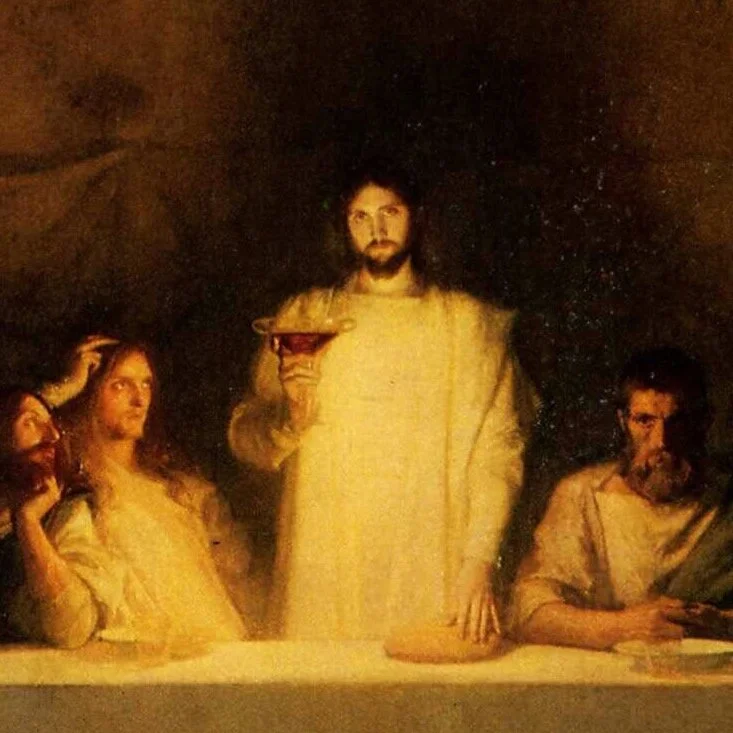
  From Mark 14:17-21: At the Last Supper Jesus “took bread, and blessed, and broke it, and gave it to them, and said, ‘Take; this is my body.’  And he took a cup …. And he said to them, ‘This is my blood of the covenant’.”

In the first decades of the Church’s life St. Paul gives witness to Eucharistic faith in his writings.

From 1 Corinthians 10:16: “The cup of blessing which we bless, is it NOT a participation in the blood of Christ?  The bread which we break, is it NOT a participation in the body of Christ?”

From 1 Corinthians 11:27-30: “Whoever, therefore, eats the bread or drinks the cup of the Lord in an unworthy manner will be guilty of profaning the body and blood of the Lord.  Let a man examine himself, and so eat of the bread and drink of the cup.  For any one who eats and drinks without discerning the body eats and drinks judgment upon himself.  That is why many of you are weak and ill, and some have died.”

These are rather inexplicable words for St. Paul to utter – that receiving Holy Communion unworthily, to take it without examining oneself or discerning what it truly is, is to eat and drink judgment upon oneself, causing sickness and death – these are strange words indeed if the faith of the Church was that the Holy Eucharist is only symbolic.  Writing almost one hundred years after the death of St. Paul, we find the words of St. Justin, a martyr, that show us the requirements for admission to the Holy Eucharist: “we call this food Eucharist, and no one may take part in it unless he believes that what we teach is true, has received baptism for the forgiveness of sins and new birth, and lives in keeping with what Christ taught” (CCC #1355).  The words of St. Justin give us three prerequisites for admission to Holy Communion: No one may take part unless (1) he believes that what we teach is true.  That means a person must be in a teaching or, we can say, doctrinal communion with the Church in order to receive Holy Communion; (2) unless he has received baptism.  That means a person must be in a sacramental communion with the Church in order to receive Holy Communion; and, (3) unless he lives in keeping with what Christ taught.  That means a person must be in a moral communion with the Lord by how he lives his life.  This ancient witness of Catholic faith and practice surrounding the Holy Eucharist tells us that these aspects of communion are prerequisites and must precede the reception of Holy Communion.  In other words, taking Holy Communion does not makes sense, and is forbidden, where a person is not first baptized and living a sacramental communion with the Church, where a person does not share the same doctrine or communion of faith, and where a person’s moral life is inconsistent with the demands of Christ.  This still applies to us today.  This means that if any one or more of those aspects of communion is not in place a person is not eligible for Holy Communion.  These prerequisites for Holy Communion that must precede reception of the Sacrament apply equally to non-Catholics and Catholics alike.  Sometimes people think that “closed communion” means only that non-Catholics are not able to receive.  That is not true.  Even a Catholic would find himself ineligible for Holy Communion were he not living a sacramental communion (as in the case of a marriage outside the Church), or were she to reject some definitive teaching of the faith, or were he to be guilty of grave sin that was not yet confessed.

If we believe that the Holy Eucharist is the Body and Blood of the Lord then these aspects of practice frankly make sense and serve to support the true faith.  If I believe that the gift of the Lord’s Real Presence is true and is here on the altar then that faith requires something of me.  It makes demands on me.  If the Lord gave the ultimate sacrifice to offer me the Holy Eucharist as nourishment, do I really think I can receive that gift without myself making sacrifice to live in communion with him?  One can see how these requirements for practice stem from the authentic faith and serve to highlight and communicate nonverbally the true faith in the Holy Eucharist.  Next, the unhappily named policy of “closed communion” can then be understood positively.  Closed communion is not observed in order to be unwelcoming or to exclude non-Catholics.  As if it were some club membership mentality.  No, it means a person must be living a full communion with the Lord before receiving Holy Communion or else the act of taking Holy Communion is lacking and may be an empty and even sacrilegious gesture or act.  And since this practice applies equally to Catholics, closed communion is not about being offensive to anyone.  Rather, it is more about recognizing the implications for taking Holy Communion: namely, that I have examined myself and I first observe a communion of life that must precede taking Holy Communion because to fail to do so is to eat and drink judgment on myself as the Scriptures say.  It is actually an act of mercy and charity to teach clearly on this and to prevent someone from unworthy communion because of the implications for eternal judgment.  If we have a spiritual vision united with the Lord we can see this quite easily.  A worldly vision will not be able to see.  With this in mind, too, it is actually an admirable expression of faith even to refrain from receiving Holy Communion where some prerequisite for communion must first be healed.  In fact, many are here in our gatherings week after week, catholic and non-catholic alike, who demonstrate an admirable faith precisely by refraining from Holy Communion.  To refrain in such instances is a sign of respect and faith and points out the reality of the Holy Eucharist just as much as someone who reverently and worthily receives the Sacrament.  We hope and pray for all such good souls that whatever temporary obstacles impede Holy Communion may be removed soon in order to live a deeper union with the Lord.  Finally, holding a proper faith and practice about the Holy Eucharist gives zeal and focus to our work as disciples to speak and to model the faith such that we bring others into a deeper communion with the Lord and his Church that ultimately can lead to a person’s ability to participate fully in Eucharistic communion.  You see, we do not receive the nourishment of the Holy Eucharist as a prize unto ourselves.  If we receive it, we do so understanding that we are called to be living members of the Body of Christ who give witness to Christ and who share in the mission of making disciples.  Our reverence at Holy Mass directs attention to the Lord in our midst.  Our commitment to take part in our Perpetual Adoration program gives us exposure to the Lord who remains in our midst and who strengthens us for mission.  Our wonder and awe at the gift of the Lord in the Blessed Sacrament of the Altar draws others into the saving work of Christ and leads them to the deeper union that gives nourishment and life to souls by the blessed and worthy reception of Holy Communion.

Audio: Holy Saturday At the Easter Vigil in the Holy Night of Easter

Audio: Holy Saturday At the Easter Vigil in the Holy Night of Easter

Homily for Holy Saturday At the Easter Vigil in the Holy Night of Easter by Fr. Stephen Hamilton.

Reading I Gn 1:1—2:2

Responsorial Psalm Ps 104:1-2, 5-6, 10, 12, 13-14, 24, 35

Reading II Gn 22:1-18

Responsorial Psalm Ps 16:5, 8, 9-10, 11

Reading III Ex 14:15—15:1

Responsorial Psalm Ex 15:1-2, 3-4, 5-6, 17-18

Reading IV Is 54:5-14

Responsorial PsalmPs 30:2, 4, 5-6, 11-12, 13

Reading V Is 55:1-11

Responsorial Psalm Is 12:2-3, 4, 5-6

Reading VI Bar 3:9-15, 32--4:4

Responsorial Psalm Ps 19:8, 9, 10, 11

Reading VII Ez 36:16-17a, 18-28

Responsorial Psalm Ps 42:3, 5; 43:3, 4

Epistle Rom 6:3-11

Responsorial Psalm Ps 118:1-2, 16-17, 22-23

Gospel Mark 16:1-7

Read More

Audio: Solemnity of Mary, Mother of God

Audio: Solemnity of Mary, Mother of God

Homily for the Solemnity of Mary, Mother of God by Fr. Stephen Hamilton.

‘Called in the Gospels "the mother of Jesus", Mary is acclaimed by Elizabeth, at the prompting of the Spirit and even before the birth of her son, as "the mother of my Lord". In fact, the One whom she conceived as man by the Holy Spirit, who truly became her Son according to the flesh, was none other than the Father's eternal Son, the second person of the Holy Trinity. Hence the Church confesses that Mary is truly "Mother of God"‘ (Theotokos). (CCC 495)

Reading 1 NM 6:22-27

Responsorial Psalm Ps 67:2-3, 5, 6, 8

Reading 2 GAL 4:4-7

Alleluia HEB 1:1-2

Gospel LK 2:16-21

Read More

Audio: The Nativity of the Lord (Christmas) - Mass During the Night

15708B07-C0A4-4D84-96BC-98152058E0A5.jpg

Homily by Fr. Hamilton at the Mass During the Night on the Solemnity of the Nativity of the Lord (Christmas).

Reading 1 Is 9:1-6

Responsorial Psalm Ps 96: 1-2, 2-3, 11-12, 13.

Reading 2 Ti 2:11-14

Alleluia Lk 2:10-11

Gospel  Lk 2:1-14

The Nativity of the Lord (Christmas) - Mass During the Night
Fr. Stephen Hamilton

Audio: Fourth Sunday of Advent

Audio: Fourth Sunday of Advent

Homily for the Fourth Sunday of Advent by Fr. Stephen Hamilton.

When King David was settled in his palace,
and the LORD had given him rest from his enemies on every side,
he said to Nathan the prophet,
“Here I am living in a house of cedar,
while the ark of God dwells in a tent!”
Nathan answered the king,
“Go, do whatever you have in mind,
for the LORD is with you.”
But that night the LORD spoke to Nathan and said:
“Go, tell my servant David, ‘Thus says the LORD:
Should you build me a house to dwell in?’“

— 2 Samuel 7: 1–5

Reading 1 2 SM 7:1-5, 8B-12, 14A, 16

Responsorial Psalm PS 89:2-3, 4-5, 27, 29

Reading 2 ROM 16:25-27

Alleluia LK 1:38

Gospel LK 1:26-38

Read More