Audio: Third Sunday of Advent
/
Homily for the Third Sunday of Advent by Fr. Stephen Hamilton.
Homily for the Third Sunday of Advent by Fr. Stephen Hamilton.
Immaculate Conception of the BVM
8 December 2025
Each liturgical solemnity in the calendar of observances of our Catholic faith is a major day worth celebrating, to be marked by rejoicing and even feasting. Such is the case today, and even more so, since our country has been given the patronage of Mary under her title of the Immaculate Conception. In other words, today’s holy day is also the patronal feast of our country and we ask Our Lady of the Immaculate Conception to pray for and intercede for our nation.
So often, there can be suspicion about how the Catholic faith honors Mary. We need not be embarrassed about our Marian devotion and how we venerate her. We call her “blessed” because God chose her for a singular role, to be the Mother of our Savior. She was given special privileges by God, gifts of grace to prepare her for her role. The Holy Spirit brought about great things in her life as she cooperated with God’s plan by her own faith. The Scriptures themselves reveal something quite clear that resonates with our veneration of Mary. When Mary went to visit Elizabeth, the Scriptures say that Elizabeth called Mary “blessed”. And what’s more, Elizabeth cried out such an honor to Mary under the inspiration of the Holy Spirit. St. Luke’s Gospel reports: “Elizabeth was filled with the Holy Spirit, and she exclaimed with a loud cry, ‘Blessed are you among women, and blessed is the fruit of your womb’!” And Mary herself goes on to proclaim, “henceforth all generations will call me blessed” (Lk. 1:41b-42, 48b). And so, we do.
We honor Mary and we call her Blessed.
The observance of aspects of Mary’s life reveals the depth of intellectual life, prayer, and reflection in the Catholic tradition about the truths of the faith and the implications of what we believe. The Catechism says the following: “What the Catholic faith believes about Mary is based on what it believes about Christ, and what it teaches about Mary illuminates in turn its faith in Christ” (CCC, 487). Today, we observe that we believe one special gift from God to Mary was that at the first moment of her life, at her conception in the womb of her own mother, Mary was conceived without any stain of sin. Referring back to that Catechism quote, this belief about Mary is based on what we believe about Jesus Christ. And what do we believe about Jesus? We believe that He is the Second Person of the Blessed Trinity, that He is God. And we believe that the Son became incarnate in the womb of Mary, that he is the fulfillment from the Book of Genesis of the offspring of the woman, who would accomplish the Father’s plan of salvation by being at enmity, at war, with the devil and his offspring (cf. Gn. 3:15). The Son of God received human flesh, his human nature, from Mary. But with an intellectual life marked by deep reflection, we have to ask how this could happen because we immediately have a problem if Mary could only transmit a fallen human nature to the Son, if she could only transmit sinful human flesh to the Son. You see, in His proper being, and especially in His heavenly dwelling, God cannot coexist with sin. The Scriptures tell us repeatedly how abhorrent sin is to God, how much it offends Him. Sin created a distance from God and heavenly life that only He, God, could bridge. And to bridge that gap, to pay the price, Someone no less than God Himself had to die to save us. The Book of Revelation gives us a vision of God’s dwelling and the incompatibility of sin when it says, “Nothing unclean shall enter it, nor any one who practices abomination or falsehood” (Rev. 21:27). So, what we teach about Mary’s Immaculate Conception is in direct relationship and illuminates our faith in Christ. In other words, the Son of God determined to become incarnate, yet He could not unite His being to sinful human nature. Mary is a real human being existing after the fall in the Garden of Eden. She would have contracted original sin and thereby could only have transmitted sinful human flesh to the Son, unless… Unless God somehow provided and prevented this from happening. And this is the heart of today’s mystery. We believe that the Son of God became incarnate in Mary. And we believe that He could not have joined himself to sinful human flesh. Thus, what we believe about Jesus is in direct relationship to this belief about Mary. God must have done something to make it possible that Mary would give to the Son sinless human flesh that He would unite to Himself in the unified being born from her, who we call Jesus Christ our Savior.
In the Immaculate Conception we are saying that God gave Mary a special privilege and that he acted in an entirely unique way to save her from the most moment of her life, at her conception. God saved her in a different way, but He still saved her. God saved her by preserving her from sin at the moment of her conception. In the Immaculate Conception, we are being asked to believe that God, for Whom everything is eternally present and Who knows and sees all things, could apply the value of Jesus’ saving death to Mary even before the Cross happened historically. In other words, God could apply the sacrificial value of the Blood of Jesus to Mary from the moment of her conception. This feels or sounds like some sort of theological time travel, right? At least to us due to our relationship with time. But that is not so for God; that is not how God relates to time. But it is not at all surprising really. The Scriptures show, and we believe after all, that the blood of the Old Covenant sacrifices was able to atone for sin and provide some sort of remedy for all humanity who existed for centuries before the coming of Jesus. No one believes that the blood of lambs or goats could provide eternal salvation. Rather, Christians profess that God chose to see in the blood of the Old Covenant sacrifices a foreshadowing of the Blood of His Son. The blood of the Old Covenant was a temporary remedy in view of what would be fulfilled in Jesus. And if we believe that, if we believe that God could choose to see in animal blood a foreshadowing of the saving Blood of Jesus, and allow that animal blood to be a remedy, albeit a temporary one, is it really some outlandish catholic idea that God could see the saving value of the death of Jesus and apply that eternal remedy to Mary even before the historical moment of the Cross? The Catholic faith says this is not an outlandish idea or one that is inconsistent with faith and the Bible.
Observing the Solemnity of the Immaculate Conception of Mary we contemplate the threshold of our salvation, because we celebrate the gift of God to Mary, the one He chose to be the Mother of our Savior. As we celebrate today how she was conceived free from all stain of sin in her mother’s womb, the womb of St. Ann, we celebrate that God was making good on His promise to save mankind. Today we celebrate the role He prepared Mary to occupy to bring us that Savior. Looking to Mary and counting on her prayers for us we can walk confidently toward God trusting that by sincerely doing away with sin in our own lives, by confessing it, and seeking to observe greater obedience to God now, we will be prepared one day to enjoy the fullness of obedience’s reward in the eternal life of Heaven.
Homily for the Solemnity of the Immaculate Conception of the Blessed Virgin Mary by Fr. Stephen Hamilton.
Reading 1 Genesis 3:9-15, 20
Responsorial Psalm Psalm 98:1, 2-3ab, 3cd-4
Reading 2 Ephesians 1:3-6, 11-12
Alleluia See Luke 1:28
Gospel Luke 1:26-38
Read MoreHomily for The Solemnity of Our Lord Jesus Christ, King of the Universe by Fr. Stephen Hamilton.
Dominica D.N. Iesu Christi Regis
23 November 2025
The Church’s liturgical year comes to a close this week with this final Sunday before a new Church year and the new liturgical season of Advent begins next Sunday. In recent decades this final Sunday of the year is called the Solemnity of Our Lord Jesus Christ, King of the Universe, commonly referred to as the Solemnity of Christ the King. The liturgical celebration of the kingship of Christ is rather recent in Church history, coming about when Pope Pius XI established this solemnity in 1925.
Now, popes don’t just randomly decide and decree things without some reason. There is some context, some need to which they are responding when they teach. In the case of this liturgical solemnity, the Pope decreed this observance when the world, especially Europe, was dealing with the fallout from World War I. The world was devastated by that war. There were some estimated 30 million military casualties and an estimated 8 million civilian casualties from war-related causes and genocide. Troubling and godless political movements and ideologies were also on the march across Europe. Lives were devastated, society was splintered by divisions, and peace had been torn apart.
Pope Pius XI wrote, The “manifold evils in the world were due to the fact that the majority of men had thrust Jesus Christ and his holy law out of their lives; that these had no place either in private affairs or in politics: and we said further, that as long as individuals and states refused to submit to the rule of our Savior, there would be no really hopeful prospect of a lasting peace among nations. Men must look for the peace of Christ in the Kingdom of Christ; …. it seemed to Us that peace could not be more effectually restored nor fixed upon a firmer basis than through the restoration of the Empire of Our Lord” (Pius XI, Encyclical Quas Primas, On the Feast of Christ the King, December 11, 1925, n.1; emphasis added).
As disciples of the Lord and as members of his Church we observe the kingship of Christ not only liturgically, but most fully by striving for deeper conversion, repentance from sin, and by submission to the reign of Christ, so as to live a life of greater holiness, in other words recognizing that the kingdom of Christ is to be within us. To speak of living holy lives really means that we are living here and now as members of the kingdom of Christ while we await full arrival in that kingdom at the Lord’s Second Coming.
We live in a fallen world and we live in an age that is marked by curious parodies of divine truth, by which I mean secular ideals and movements that parody salvation history. I have a theory that I have not had time to develop that in our fallen world due to the dominion of the evil one, the truths of the faith and the events of salvation history are mirrored in this world, but twisted or inverted so as to be a parody of salvation history. At the risk of offending, though it is not my intention, one such parody of a social movement happening in the general time that we catholics are observing the kingship of Christ is the “No Kings” movement, which just might plant in people’s minds attitudes that could risk being transferred into one’s faith life, such that a person might reject the serious call to submit oneself to Christ and his reign, rejecting Christ as King. It might be thoroughly American to say that our form of government is not a monarchy, but it would be thoroughly unchristian and would be a risk to salvation were one to reject that Christ is King, that he is my King, and that he must reign in my mind, in my heart, and in my actions.
The Scriptures reveal that the Lord Jesus is the promised king in the line of David. Our first reading today shows David solidifying kingship of the tribes of Israel in the northern kingdom together with the tribes of the southern kingdom. David made a covenant with the tribes and, the first reading told us, “they anointed him king.” In the ancient world, a person became king by being anointed. That actually still happens today. Thus, when Jesus is referred to as the Christ, meaning the anointed one, there is a fulfillment of the promised king whose kingship would be firm and whose kingdom would never end. Ironically enough, as we see in the gospel passage, Jesus is referred to as the Christ, the anointed one, while he hangs on the Cross. He reigns in an entirely different way. His throne is the Cross. By this we learn that Jesus is a king, but he is not an earthly king. He does have a kingdom, but it is not an earthly kingdom.
As we celebrate the kingship of Christ, we are called to recognize that by faith and baptism we have been incorporated into the kingdom of Christ. Yes, we are still awaiting its fulfillment in the life to come since his kingship is not limited to this earth or this life. But we participate in the kingship of Christ now by submitting to his commands, his call to sacrificial and self-giving love, and by conforming ourselves more deeply to the moral life. By submitting to Christ now we gradually undo the rebellion of sin in ourselves and we foster an order in our life and in our world that will promote true flourishing and the possibility of greater peace. By professing Christ Jesus to be our King and by professing his dominion over the whole universe and over our very selves, we find that we are submitting ourselves to the one who has submitted himself to us and who, for our salvation, has mounted the throne of the Cross. We come here to experience the saving mystery of the cross at Holy Mass where we, sinful thieves that we are, look upon the Lord and say in humility, “Jesus, remember me when you come into your kingdom.” May we train our minds and our hearts to hear his royal decree, “Amen, I say to you, today you will be with me in Paradise.”
All Souls’ Day
2 November 2025
All Souls’ Day Masses this weekend are Memorial Masses whose characteristics are much like that of a funeral, the difference being that there is no body of a deceased person present in these Masses. But the Scripture selections, prayers, and symbolism are much the same as in a funeral. The Church’s Sacred Liturgy contains her doctrine and it is an instrument by which the Church’s belief is transmitted. This transmission of doctrine in the sacred liturgy does not take place in some didactic way, as if the liturgy is like being in a classroom. Rather, the Church’s liturgical rites transmit her doctrine by means of forming a culture in which we naturally receive, or are shaped in, the Church’s faith. Thus, with the rare occurrence of All Souls’ Day replacing the normal weekend Masses, I want to highlight some of the Church’s theology and liturgical practice surrounding funerals, contrasting it with some problematic cultural practices surrounding funerals. I think this is a timely and necessary sermon topic given some cultural trends surrounding death and funerals. I want to emphasize that when I raise examples of popular trends that should be avoided by a catholic, I am not making fun of anyone or intending to indict anyone for past funeral choices. My duty is to instruct you here and now so that there is better information for the future. Obviously, I am only referring to Catholic funerals and practices. Other groups who are not catholic might have different practices and are not bound by catholic practice.
“In the face of death, the Church confidently proclaims that God has created each person for eternal life and that Jesus, the Son of God, by his death and resurrection, has broken the chains of sin and death that bound humanity” (Order of Christian Funerals, Praenotanda, 1). “The proclamation of Jesus Christ… is at the center of the Church’s life” (ibid., Praenotanda, 2). This proclamation of Christ and his victory over death is also at the heart of the funeral rites of the Catholic Church. “Christians celebrate the funeral rites to offer worship, praise, and thanksgiving to God for the gift of a life which has now been returned to God” (ibid., Praenotanda, 5).
With this summary theology in mind, and since the Church is always seeking to proclaim Jesus Christ, a catholic funeral has two main focuses. First, in charity and mercy the Church prays for the deceased person, so that he or she be purified of sin and able to enter heaven. This is a charity that we ourselves will count on one day. Second, the catholic funeral also seeks to bring consolation to the family and friends of the deceased for whom grief can be a time of testing and doubt. A catholic funeral is never primarily about the life of the deceased person. It is primarily about the life, death, and resurrection of Jesus Christ. If a funeral is a celebration of anyone’s life, it is a celebration of the life of Jesus Christ and then, secondarily, how the life of the deceased person participated in the life of Jesus. Thus, terms such as “Requiem Mass” or “Funeral Mass” or “Mass of Christian Burial” better describe a catholic funeral than does the tendency to refer to a funeral as a “celebration of life” or a “celebration of the deceased”.
There are certain customs of culture that may have a place at a catholic funeral, but it is important to remember that the funeral rites are the Church’s ritual. It is the Church who owns it, and not the person receiving the ritual. Thus, funerals are the Church’s ritual, expressing her authentic Christian faith, and are not the property of any one person who might prefer to cater a funeral to his or her own preferences. There are trends in the funeral industry and in funeral ceremony planning that should not be part of a catholic funeral. Here are some real-life examples that I have encountered: The funeral is not a time to play the deceased person’s favorite Sinatra song or the fight song from their college alma mater. It is not a place to bring in a vaguely spiritual sounding song that appears on a Josh Groban album. The catholic funeral is not the place to wear the jersey of the deceased’s favorite sports team or to place cremated remains in a tackle box because “he really loved fishing”.
It needs to be said that we don’t presume to know in most cases that a deceased person is already in heaven. We might say they are “free of their burdens” or that they are “in the hands of God” or that they “have entered eternity”. But to claim that they have already successfully passed judgment and are in heaven is a rather bold claim that should be avoided in most cases. You can understand how superficial that claim is when I highlight the opposite claim as a joke: Have you ever been to a funeral where someone said the deceased is in hell? Yeah, I’m still waiting too! We do not know the state of a person’s soul. But we have hope for the soul because of God’s tremendous love and mercy. When we adopt an erroneous theology that claims a person is already and automatically in heaven, we are also undercutting the urgency to pray for the deceased. Why would I pray for someone’s repose if he or she is already in heaven? We, Catholics, pray for the deceased. The custom of having Mass intentions scheduled through the office for a deceased person should be part of our culture. The Holy Mass is the highest prayer we have, by which the sacrifice of Christ for our salvation is made present to us. Thus, it is a great honor and, more importantly, a great spiritual value to have a Mass offered for deceased family and friends. In your own funeral plans, you might instruct the executor of your will to have a certain number of Masses offered for your repose from the estate. In addition, you should expressly state your desire for a Catholic funeral that reflects your faith. This is especially helpful if your survivors are not practicing catholics. Another claim that should be avoided, a claim you often hear when someone dies, is that the person has become an angel. When someone dies, you might hear the comment “heaven has gained another angel”. That is not a true statement and it is contrary to Catholic teaching and contrary to logic. We human beings are our own proper being as body and soul. Death does not mean we become a different level of being. In other words, we do not go higher to become angels. In a similar way, we do not go lower to become animals after death. And, thanks be to God for that!
The issue of cremation needs some clarity. From the funeral ritual we read: “Although cremation is now permitted by the Church, it does not enjoy the same value as burial of the body. The Church clearly prefers and urges that the body of the deceased be present for the funeral rites” (ibid., Praenotanda, 413). This preference is motivated by honoring the body which, in baptism, had been made a temple of the Holy Spirit. There are signs in the funeral ritual showing the Church’s preference that the body be present: only a body in the casket is vested with the pall, the large cloth that recalls baptism, which is placed over a casket at the beginning of the funeral Mass. Cremated remains do not receive the pall. This is easily understood because only a body is vested; ashes are not vested. Where there is some compelling reason to choose cremation, and there may be reasons, and provided that cremation is not chosen as a sign of rejecting our faith in the resurrection of the body, you might consider the option that funeral homes now provide: namely, you can make use of a temporary casket for the funeral Mass, permitting the body to be present at the Mass, and have cremation after the Mass with burial to follow as soon as possible. This is also a good place for me to note that proper disposition of the body or cremated remains is required for a catholic funeral. The body, of course, demands prompt burial. When we are dealing with cremated remains there must be a specific plan for proper burial or entombment. While some delay in burial may be understandable in certain cases, one may not keep ashes. Scattering of ashes is also not permissible for a catholic funeral. Ashes should not be separated with portions given to survivors for keeping. The entirety of the ashes must be put in a burial place. This might surprise you, but it is a real trend: It is also unacceptable to have cremated remains compressed into shapes, turning them into jewelry or decorations.
I wanted to say more about why there is no Gloria at a funeral Mass, the special candles, the color of vestments, and why the altar is not vested in black, but this sermon was getting too long. Maybe I will put out a document that explains more.
In conclusion, we want what is most important to be clearly visible at our funeral rites: our faith in Jesus Christ risen from the dead. With that focus, we then observe a funeral in hope based on the generous mercy of the Lord and so we pray for the healing of sin for the deceased and the final entrance into Heaven. There is sadness when someone dies, rightly so in many cases. But there can also be joy in focusing on what should truly matter to us as Catholics, a life well-lived in the Lord. That should inspire our living right now, so that we are prepared for that day that comes to us all when we shall pass from this life to the next.
[Let’s pray now the Eternal Rest prayer for the deceased]
Homily for the Twenty-eighth Sunday in Ordinary Time by Fr. Stephen Hamilton.
Dominica XXVIII per Annum C
12 October 2025
The first reading and the Gospel selection follow a remarkably similar narrative. A leper, who is a foreigner, is cleansed and has enough awareness to notice, to make a return, and to thank God in adoration and homage. Two lepers. Two non-Jews. Two who are not part of God’s People. Only these are aware of the gift they are given; only these make a return; only these thank God. And because their eyes are open to the gift and because their hearts are filled with gratitude, they receive still more from God: not only physical healing but the salvation of their souls that unites them to God’s People and to the worship and sacrifice offered to the true God!
Over time the biblical imagery of the physical malady of leprosy has become a figure of spiritual malady. While we are not concerned about the transmission of leprosy in our community, we can apply a broader spiritual lesson to our lives. In particular, I want to encourage an application of the lesson to our life as Christian stewards. The spiritual lessons come from what the Gospel tells us happened as the lepers were leaving Jesus. Listen again, “As they were going they were cleansed. And one of them, realizing he had been healed, returned, glorifying God…; and he fell at the feet of Jesus and thanked him.” Some fundamental but critical spiritual lessons come from this description. These lessons from the one leper should be part of our lives. The lessons are threefold: realizing, making a return, and glorifying or thanking God.
The lesson of realizing is being aware of what God does for us, being aware of what is given us, and how we are blessed. It is a self-awareness and an awareness about God. It is not a call to self-absorption, but rather it is a lesson to be more reflective, prayerful, and recollected so that we take notice of what is happening in us and around us, especially as it regards our life with God. Being aware in the spiritual life takes effort and practice. We are often so busy about the things of the physical realm, the things our senses can perceive, that we leave largely untrained and undeveloped the skill of taking notice of our soul and the movements of the spiritual realm. The simple comment of the Gospel highlights, however, just what a difference this lesson makes. All the lepers were cleansed. Apparently only one was aware. Only one noticed. Only one realized. The other nine kept going their way. The awareness of the one, led him back to a deeper encounter with God Himself. See, then, how important a practice awareness is?!
The second lesson is making a return. When we are reflective and train ourselves in spiritual awareness we are less likely to miss what is going on in our life with God. Being more in tune with God’s movements and His blessings in our lives, we then are in a position to respond by making a return to Him. Without developing this lesson, we risk, like the other nine lepers, going on our merry way unaware of both how we have already been blessed by God and how we might be still more blessed if we made a return and remained in God’s presence, remained where He is clearly bestowing His blessings.
The third lesson is glorifying and thanking God. God deserves and is owed our praise. Recall the Alleluia verse? “In all circumstances, give thanks!” Our individual prayer, our virtuous living as temples of the Holy Spirit, and our worship at Holy Mass and adoration in the chapel are all important ways we glorify God. Given that the Greek word for “giving thanks,” used in this Gospel passage when the one leper thanked Jesus, given that the word is eucharisteo, we have a clear connection to the Holy Eucharist. This takes on a deeper meaning for us as Catholics in that being present at Mass to worship and taking time to be before the Lord in our adoration chapel are clear connections to the giving thanks that is the very heart of the Holy Eucharist.
What we see in this Gospel passage is that these spiritual practices of realizing what God is doing, making a return, and glorifying and thanking Him in Jesus, are not only appropriate ways by which we celebrate what God generously gives us, but these practices open us to even more blessings from God. Notice all ten lepers received the blessing of healing, but only the one received still more, for he heard that not only his flesh, but his soul, was healed: “Stand up and go; your faith has saved you.”
Given today’s Gospel lessons about awareness, making a return, and giving thanks we might ask ourselves: Do I seek to be aware and to count the blessings I have? Am I grateful to God for what He has done in my life? Do I thank Him in the prayers and offerings of the Holy Mass? Do I thank Him by making a commitment to time in adoration in our chapel? Am I grateful for the people and things, the skills and blessings, God has put into my life? How do I express that gratitude? Do I give back to God? I think awareness, gratitude, and stewardship have a direct connection: When you take time to reflect, and to notice, and to be aware of the gifts you have been given, you quite easily want to give back. This is the habit I urge you to form. It will reap benefits in your life. It will reap benefits in our parish life as we seek to meet the demands of running a parish. And it will reap benefits in the lives of others we seek to serve.
In today’s passage faith is what saves the leper. Awareness/realizing – making a return – thanking God – and increased faith and trust all go hand in hand. If you will work to be reflective and aware in your spiritual life, you’ll find more blessings. You’ll be more grateful. It will be much easier to give back to God. And you will receive still more, since your awareness and gratitude lead you back to God in all things, helping you remain in His sight and in the place where He bestows richer blessings than you can imagine.
Dominica XXVII per Annum C
5 October 2025
For many weeks now we have been hearing the Lord’s teaching while on an extended journey to Jerusalem. This section of St. Luke’s Gospel contains many challenging parables. We have heard parables about the cost of discipleship over these weeks. We have heard parables about repentance, being lost, and the extravagant mercy of God who searches us out. We have heard parables about the proper use of wealth and riches, and the call to put our resources at the service of others as good stewards. Today we are reminded that we are servants who have duties to fulfill and that we ought not fulfill those duties as if expecting some particular praise or reward for doing what we simply should do. We have done only what we were obliged to do, to use words from the Gospel. We each face many challenges in life and in living the faith. We are not promised that we will navigate this life without difficulty. We are not promised that the final resolution to suffering and challenge will be here in this life. With this in mind, I bet the prayer of the Apostles could easily be the prayer each of us makes to Jesus: “Increase our faith.”
Now the Apostles by this point certainly already had faith. They had a type of faith. They had encountered Jesus, and they had been changed. They had come to believe in him. Yet, they must walk with him and journey through life encountering all the things, all the ups and downs, that life brings to any one of us. That the Apostles ask that their faith be increased is a reminder to us that faith is not static. It is something that must grow. We might even consider that hearing the series of challenging parables from the Lord, parables presented to us these past many weeks, we might suggest that the Apostles, in asking “increase our faith”, are also asking that their trust be increased. The personal trust of the believer is, after all, another meaning of the word “faith”. In other words, they are not seeking only the faith that believes intellectually in things (that is one meaning of the word “faith”), but also the faith that leads them to deeper trust to maintain their relationship with the Lord through all that life brings.
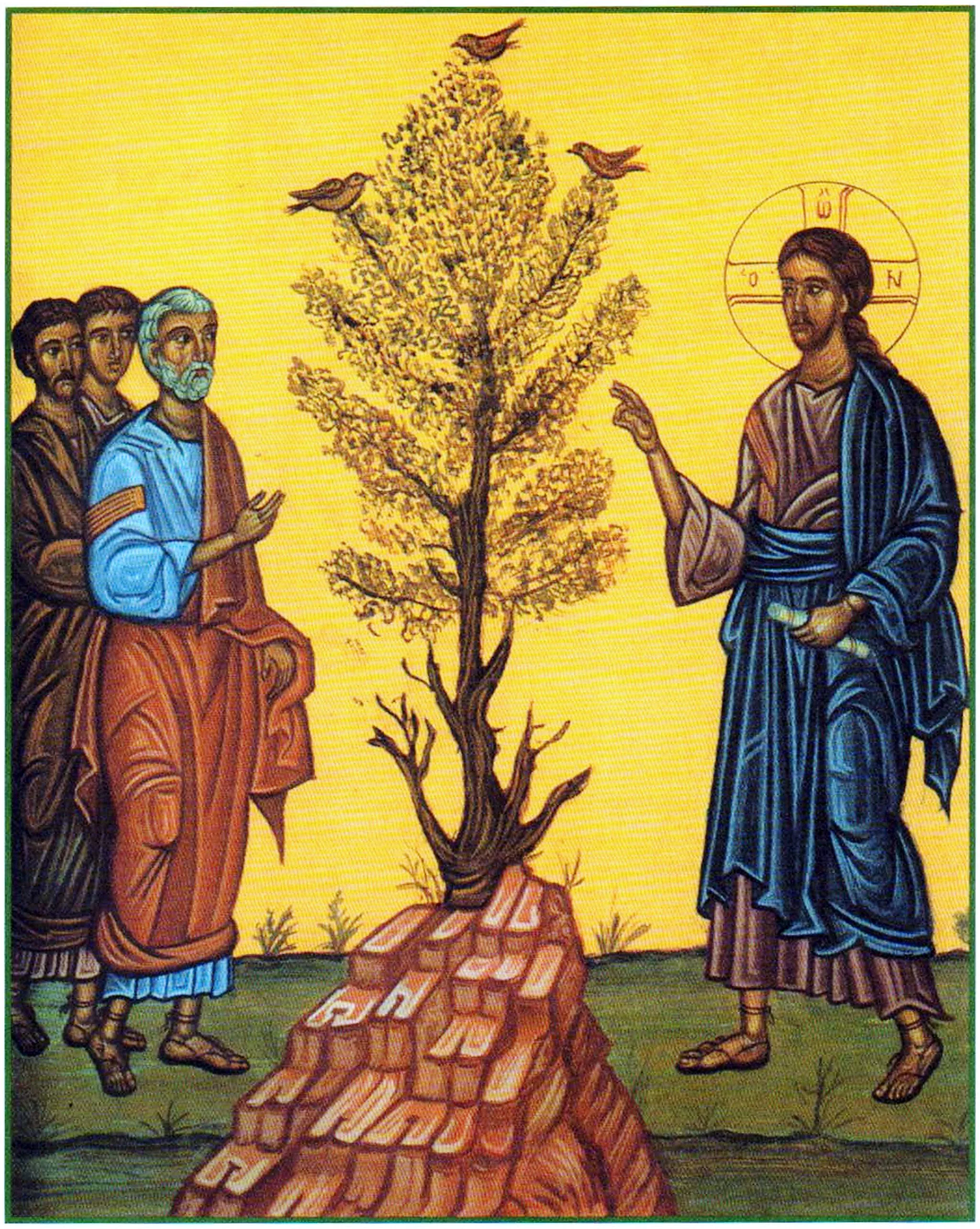
Responding to the prayer for increased faith, increased trust, Jesus uses the simple example of the mulberry tree. He says, even if you have only a little faith, “you would say to this mulberry tree, ‘Be uprooted and planted in the sea,’ and it would obey you.” The example highlights two unlikely, and even impossible things. First, a mulberry tree is known to have such a broad, expansive, and deep root system that it is unlikely you are going to uproot it. Second, a tree is not going to be planted in the sea and survive. The idea with this image then is that faith has the ability to do things beyond our capabilities. Faith can do the seemingly impossible. And it does so, not because of us but, because of God’s power. It is God who accomplishes things when we let Him act, when we give up the control we like to maintain, when we have faith that calls out to Him for things we ourselves cannot achieve.
Each of us faces moments and events of life that test us and that leave us feeling powerless. The first reading from the Prophet Habakkuk demonstrates this and uses words that might resonate with us in our challenges. “How long, O Lord? I cry for help but you do not listen!... Why do you let me see ruin; why must I look at misery?” Again, in this fallen world we are not promised an easy passage. Suffering comes and it may last for a long time and it may come frequently. We want answers and solutions and happy resolutions here. But the word of the Lord through the Prophet Habakkuk calls us to have faith in the vision of the Lord’s promises to come. That vision, the Lord says, “presses on to fulfillment…. If it delays, wait for it, it will surely come…. The rash one has no integrity; but the just one, because of his faith, shall live.” There will be challenge and suffering in this life, yes, but the one who has faith shall endure and shall live.
And so, we come to the words of Psalm 95, the responsorial psalm of this Holy Mass, a psalm that the Church prays daily at the first prayer time of each day in the Liturgy of the Hours, called the Invitatory. That psalm begins by referring to the Lord God as the Rock of our salvation. That image is not just a generic image for strength and solid foundation. Rather, it is a direct reference to the experience of God’s People in the exodus and desert wanderings. The rock is the rock that Moses struck to provide the people water in the desert at Meribah and Massah. There, as the people were being led by God and provided for by Him in the desert, they were given water to drink yet at the same time they doubted. They failed to completely trust. In the very moment of being provided water the people were saying, “Is the Lord in our midst or not?” The harshness of the desert caused them to forget and to doubt, and to do so quickly. And so, the section of the psalm we use today references that very event saying, “Harden not your hearts as at Meribah, as in the day of Massah in the desert, where your fathers tempted me; they tested me though they had seen my works.” It's a clear connection for us that the Church is making to the difficulties and harshness of this life and how it causes us to forget God and to doubt, and to do so oh so quickly.
The Church recognizes the challenges that life brings and recognizes that even in the midst of blessings and God’s workings among us we are tempted to doubt and to lack faith. The Church recognizes that we need greater trust because we lose perspective and focus in the “deserts” of our life, the deserts of our personal suffering, and also the deserts of so much suffering, war, poverty, hopelessness, and senseless violence around us. Just like the People of Israel did, we, too, have our places of contention and grumbling and testing. We have “our Meribahs” and “our Massahs”. And so, at the beginning of each day in the Liturgy of the Hours, not knowing what may come our way, the Church places on our collective lips this very experience from the desert wanderings. Whether you pray the Liturgy of the Hours or not, the whole Church is speaking and praying these words through priests, religious, and those lay people who do so. We use these same words today, “If today you hear his voice, harden not your hearts.” Like the Apostles we call out to the Lord, “Increase our faith.” We are not asking only for an increase of intellectual assent and belief, as important as that is. Rather, we are also begging the Lord to increase our trust in His presence and His saving action in our lives and in our world, which needs Him so desperately in this valley of tears. We beg that our vision and perspective may be purified in all things – all the moments and events and the deserts that life brings us – that we may let God work to do the things we cannot see or achieve on our own.
Homily for the Twenty-seventh Sunday in Ordinary Time by Fr. Stephen Hamilton.
Reading 1 Habakkuk 1:2-3; 2:2-4
Responsorial Psalm Psalm 95:1-2, 6-7, 8-9
Reading 2 2 Timothy 1:6-8, 13-14
Alleluia 1 Peter 1:25
Gospel Luke 17:5-10
Read MoreHomily for the Feast of the Exaltation of the Holy Cross by Fr. Stephen Hamilton.
Feast of the Exaltation of the Holy Cross
14 September 2025
I want to focus on the selection from the Book of Numbers. It is important for this feast, but also for appreciating the sacramental life that is such second-nature to Catholics. The Catholic Faith professes belief that God’s decision to unite Himself to the created world by taking on human flesh in the incarnation has important implications. One implication is that matter, the stuff of the ordinary world around us, can be used by God and raised to a special purpose. God’s use of created things means that just beyond what our senses can perceive in the ordinary is a deeper reality of things extraordinary. This implication is a foundation of how we understand the sacraments, those seven special gifts of God’s life and power. For example, water is part of the natural process of giving birth, water supports life, and water is used to wash clean. In and of itself, the substance, the stuff of water has no power to bring about spiritual life or to wash sins away. However, when employed by God in the sacrament of baptism, water is part of the process of coming to spiritual birth, baptismal water supports the life of the soul, and baptismal water cleanses us from sin. Sacraments, because they are established by Christ, are obviously New Covenant realities that did not exist in the Old Covenant. However, given that Catholicism can be so misunderstood and suffer from claims of not being Bible-based, I think it is so important for us to see just how consistent with Scripture our faith is. I want to make a claim that some might find surprising. Though sacraments, properly speaking, are new covenant realities, the logic and principle of the sacraments, meaning how sacraments work, is already present in the Old Covenant and visible in selections like today’s from the Book of Numbers. In other words, hundreds of years before Jesus established the seven sacraments in his Church, the idea of what a sacrament is can already be seen in God’s action in the Old Testament.
Consider the event of the first reading. God’s people complained about the harsh conditions in the desert as He was leading them away from Egypt. As punishment for their rebellion against Him and their lack of faith, God sent poisonous snakes. Those who were bitten died. When the people cried out for mercy, what was God’s response and solution? God gave the curious instruction that Moses was to make the figure of a snake and raise it on a pole. Those who looked up at the snake were saved from the effects of the poison. That is the logic and the principle of how the sacraments work. And that is in the Old Testament, well before Jesus and well before his Church! There is nothing about bronze, or the shape of a serpent, or about raising something on a pole that saves a man from the poison of venom. God certainly didn’t need to use such things to save His people. But He chose to use the matter, the ordinary stuff of the world to be a vehicle by which he would accomplish this saving action. And thus, something that has no life-preserving power (bronze, serpent, a pole) does have such power when employed by God according to His will. While we may not know why God chooses to act in this way, we might reasonably suggest that, in at least some cases, God chooses to respond to His people’s needs in sense perceptible ways so that His people know He is present and active. He Himself doesn’t need sense perceptible ordinary things. But in His mercy, He chooses at times to make use of such means for human beings who do interact with the created world through the senses. The event of the bronze serpent shows us the logic and principle of the sacraments, and it shows us this at work even in the Old Testament.
Now let’s look at what the bronze serpent teaches us about the Holy Cross. First, notice the inconsistency in the complaint of the people. They complain that God has taken them into the desert “where there is no food or water”. Yet, the very next complaint is, “We are disgusted with this wretched food!” In other words, yes, the desert is harsh, but God provides for them. The issue is that they simply do not like the way God provides nor what He provides. In fact let’s recall, God had already given them water from the rock, quail, and the bread-like substance called manna. So, when we read that the Israelites express disgust at this wretched food, we should recognize those words for the ingratitude and sacrilege that they are. It is deeply offensive to God’s generosity. And thus, the punishment of the saraph serpents. Also, notice how God answered their prayer for mercy. The Israelites asked Moses to “pray the Lord to take the serpents from us”. God answered the prayer, but He did not take the serpents away. Rather, He provided a method by which the people could be preserved from the effects of the venom. The very implication of making a bronze serpent to be looked upon means that the saraph serpents were still there, people were still being bitten, but now they had a way to be saved. And what was that way? Those bitten had to look upon, to gaze upon the bronze serpent. What did that accomplish? The people had to look upon the effects of their complaining and rebellion against God. He would not let them forget their rebellion and its effects, even as He devised a plan to save them. The people had to look upon the bronze serpent and see in it a reminder of what their rebellion had brought to them. One wonders, did everyone who was bitten look upon the bronze serpent? Did some do so believing that God would save them? Did others lack faith and refuse to obey, refuse to look upon the serpent, and so die?
The bronze serpent is clearly a type of how the Lord himself would be lifted up, exalted on the Cross. The Cross of the Lord fulfills this event from the Book of Numbers. Have you ever heard criticism because catholics typically have not empty crosses, but crosses bearing the corpus, that is the image of Christ on it? Some make the claim that this is a sign that Catholics think Jesus is still on the cross, as if he has not resurrected. That is as silly of a claim as suggesting that because we like Nativity Scenes at Christmas, we still think Jesus is a baby in a manger. But more to the point, it is Jesus who saves us. It is Jesus on a cross that saves us. It is not an empty or bare cross that saves us. Again, the Book of Numbers: Did God instruct those bitten by snakes to look upon the pole only? No, He instructed them to look upon the serpent. It is not an empty or bare pole that saved them. Just so, we look upon a cross bearing the Body of the Lord because it is he who saves us. And why is it important that the cross have the Body of the Lord? Because, just like the bronze serpent, we are to look upon the effects of our sin. When we look upon the Son of Man lifted up on the cross, we must see and acknowledge what our sins do. They are deserving of death and they brought about the death of Jesus, the Son of God. God Himself came to pay the price for our sins. Only a fool would dismiss his sin and pretend it does not have real consequences. Let’s be clear, it is not an empty, thoughtless looking upon the Lord on the Cross that saves. The Gospel says, “Just as Moses lifted up the serpent in the desert, so must the Son of Man be lifted up, so that everyone who believes in him may have eternal life”. Our gazing upon the Lord cannot be a passive or empty act. It must be done with faith and conviction for it to communicate its saving effects to us.
At Holy Mass we come to participate in, and to have presented to us, the same saving grace of the one sacrifice of Christ on the Cross. Have we complained or disregarded God’s action? Have we committed our own sacrilege by disregarding the Holy Eucharist as somehow “wretched food”, or receiving it unworthily, or almost ignoring it? Do we look upon the image of the Lord’s cross in a passive way, glancing but not letting it drive us to truly believe and change our lives? Do we ignore the effects of our sin by rarely confessing, even though seeing the Son of Man lifted up should be a reminder of our sinful rebellion? Do we see in the image of the exaltation of the Holy Cross the sign of how “God so loved the world that he gave his only Son”? Do we have gratitude for the love of God and let that love motivate us to love Him with repentance, faith, and worship? At every Holy Mass, in the midst of the desert of our own struggles, we have presented to us the one same lifting up of the Lord, who gives himself to us as food, a saving remedy for the venom of sin, and protection on the journey to the Promised Land of Heaven. Yes, we look upon Christ, and him crucified (1 Cor. 2:2), because by his holy cross he has redeemed the world!
Dominica XXIII per Annum C
7 September 2025
If he had one, imagine being the Press Secretary for the Lord. At the meeting to prepare for Monday’s Press Conference, one staffer tells you, “We have a little something brewing that we better prepare for. The Lord said that you can’t be his disciple unless you hate.”
You say: “Hate. He said that, huh? Okay, well, I’m sure that was some sort of generalized comment, right?”
The staffer responds, “It was, uh, fairly specific and detailed. He said you can’t be his disciple unless you hate those closest to you, your family, and even your own life and possessions.”
“Oh my,” you say. “Let’s not overreact. I’m sure he said this, what, privately to the apostles?”
The staffer adds, “Yeah, about that… great crowds were traveling with him and he turned and addressed them directly.”
“If anyone comes to me without hating his father and mother, wife and children, brothers and sisters, and even his own life, he cannot be my disciple. Whoever does not carry his own cross and come after me cannot be my disciple.” And at the end of today’s passage, “[A]nyone of you who does not renounce all his possessions cannot be my disciple.”
These are some very tough words. We should seek to understand them and we should let them impact our way of life. I think there are two lessons to point out here.
The first is simple, but a critical foundational point. I think we should acknowledge the implicit claim Jesus is making. Jesus is a Jew. The commands of the law are normative for Jews. The commands say that the Lord is God and you should have no other gods before Him. Furthermore, God deserves the entirety of a person’s love and devotion. The first and the greatest command is that you should love the Lord your God with all your heart, all your mind, and all your strength. So, recognize the implicit claim that Jesus is making. Who can claim or demand a love and a dedication like that? Who gets to say that loving him with all that you are and all that you have is the requirement? It’s God who makes that claim! So, for the Lord to say that you cannot be his disciple if you place other relationships and other things ahead of him is an implicit claim that he is God. He doesn’t come right out and say it, but the claim results in the same conclusion. He is God and there can be no other gods before him and he deserves our first love. The one we follow is God and so we take his words seriously, including the words that seriously challenge us.
And that raises the second lesson that we need to examine for ourselves. Are we challenged by belonging to the Lord? Do we feel the pinch of following him? Let’s face it, sometimes it can be a gut punch. Do we feel the cost of following him? I belong to a few organizations that don’t require much of the membership. I bet you have a few like that too. You might pay the annual dues. Maybe you attend a meeting every once in a while. But it doesn’t require much. That cannot be the way it is with following the Lord. So, we should ask ourselves whether we feel any cost to being a disciple? If we don’t feel a cost, we might be deluding ourselves about belonging the Lord. Or at best, if we don’t feel a cost in the smaller choices we make in life, the choices in our behavior, then we might be setting ourself up for failure when the bigger costs come.
The Lord gives a clear and stark lesson in today’s gospel: Calculate the cost of the project of following him. Do you experience a cost in following the Lord? Don’t we usually sort of act as if it is only the martyrs, or the apostles, or great saints – in other words, a select few – who pay a cost, while the vast majority of us live a less costly form of being Christian? But the gospel doesn’t let us get away with that idea. Notice Jesus’ words today are not a private lesson for a select few of his disciples. Rather, the gospel is clear that Jesus addresses this lesson about cost to everyone for he is speaking not to a select few but to “great crowds.”
I should probably say something about the word “hate”. The word in Greek that St. Luke places on Jesus’ lips does literally mean “to hate”. But the context is important to understand shades of meaning. You can look at parallel passages in the other Gospels to help you understand the meaning. So, in this case, if we look at the parallel passage in St. Matthew’s Gospel (cf. Mt. 10:37) where the Lord gives this same lesson we find this wording: “He who loves father or mother more than me is not worthy of me; and he who loves son or daughter more than me is not worthy of me; and he who does not take his cross and follow me is not worthy of me.” Luke’s version is meant to be shocking and to get us calculating our lives as disciples. But with this other passage in mind, we can see that the Lord is not telling us that we should set out to hate others or our own life or our possessions, at least not in the way the word “hate” sounds to our ears. Rather, he is saying that he must have first place. We cannot prefer other relationships or our own life or our possessions to him, if we are truly his disciples. Now, in properly understanding the use of the word “hate” we should not dismiss the force of the Lord’s lesson or somehow walk away thinking that we should remain comfortable in a discipleship that costs little. No. The Gospel tells us that we must feel the cost of belonging to the Lord.
Does the time you make to be with the Lord in personal prayer require a sacrifice? Do you feel that pinch? Do other activities get attention while prayer seems to take the back seat? How might we calculate the cost of belonging to the Lord by guarding dedicated time for prayer? If worshiping the Lord at Mass is skipped, or if I’m inside these walls but texting or surfing the internet or watching videos, or if I regularly walk out of Mass early, does that demonstrate that I need to change my priorities?
Does my pattern of repentance and confession demonstrate the pinch of admitting where I am placing other things before the Lord? Am I complacent about my sins such that I remain in relationship with them and weaken my resolve to be in moral communion with the Lord?
Unconverted ears would bristle at the idea, but how Gospel-like would it be if in family relationships or dating or marriage, we could say to our loved ones, “You’re not number one in my life only because God is first.” In fact, the disciple is called to believe that to love God first and so to be filled with His love, actually helps us love others better.
Is there a cost to your possessions by being a disciple? If you calculate the cost of following the Lord, you believe that all that you have is actually His blessing to you, to be used for His glory and His mission. And in gratitude, you seek to be a sacrificial giver to those in need, to your parish, to good charities, to souls who can be served by your time, talent, and treasure. Today we are challenged to calculate the cost of how we hold onto and also how we give from our possessions and from our talents to serve others. Do you make sacrifice from your gifts?
The tough words of the Gospel today taken together with the first reading challenge us to see where true wisdom lies. We are called to see the limits of a merely human wisdom. “For the deliberations of mortals are timid, and unsure.” Loving the Lord first and giving of ourselves prepares us to be less selfish and to be more holy, more like the Lord whose life is our pattern. Following the Lord in this way prepares us on Judgment Day to be less foolish.
Dominica XX per Annum C
17 August 2025
Last Sunday, the Gospel passage gave us a clear call to be vigilant and prepared for the Lord’s return and for our coming judgment. Last Sunday’s images of servants awaiting their master’s return from a wedding and a homeowner who does not know when a thief may strike, taught us that “at an hour you do not expect, the Son of Man will come”. And while our impending judgment usually carries with it some sense of threat and fear, I noted in last Sunday’s homily that we should temper that with real hope because of the generous love of God. We have such hope because in the image of servants awaiting their master’s return, the Lord says he will have them sit at table and wait on them.
If Catholic worship were marked by spectacle and theatrics, immediately upon this summary from last week, we might have a loud record scratch sound played over the speakers to alert you to a sudden change in focus. For today’s Gospel passage gives us a rather different picture. In fact, it gives us a picture of Jesus that doesn’t fit well with modern and progressive notions of a “feel good” religion, or a religion marked by love without demands. Jesus announces that he has come to set the earth on fire. He dismisses the notion that he has come to establish peace on the earth. Instead, he says he has come to establish division. Because of him and belief in him, the Lord goes on to describe divisions among family members and in households. So much for the Prince of Peace and progressive notions of the brotherhood of man! So much for humanism passing as authentic religion! The image of setting the earth on fire goes hand in hand with the meaning here of the baptism of which the Lord speaks. Baptism is about being immersed or drowned. By referencing water and fire, the Gospel is using two images of destruction. Both water and fire were two images of how God would recreate the world in the ancient Jewish idea of the end times. God would destroy the world and then restore it by means of water and fire. In fact, think of the story of the flood and you see the ancient mind about end times and destruction leading to renewal (in that case by means of water). So, it was that a time of testing and destruction was expected by Jews, that would be marked by fire, before a time of restoration would be brought about by God. Despite what I said last weekend that was meant to temper fear and threat, it seems this weekend that we should be more wary and concerned about what things will be like when the Lord comes as judge, what things will be like when the end times take place.
The truth is, we have to hold together at one time BOTH a sense of hope and confidence in the generous love of God at our judgment AND a sense of reverent fear, a certain type of uneasiness about the end times and our coming judgment. In other words, we have to occupy the space of some tension between two extremes. We have to avoid the sin of presumption, meaning that we regard God’s commands and the punishment due for sin as of little concern, such that we presume we are among the saved. At the same time, we have to avoid the sin of despair, meaning that we have little trust in God’s desire for our salvation and we think our cause is hopeless, such that we are paralyzed in fear before the idea of the end times and our coming judgment. Both presumption and despair are sins. We have to occupy space between them, managing to challenge ourselves to battle sin and grow in holiness while, at the same time, knowing that we cannot save ourselves, but rather entrust ourselves to a loving God who does everything to make our salvation possible.
With all this in mind, we can say the Gospel seeks to correct an overly optimistic expectation about eschatology (a word meaning belief about the end times). Jesus tells his disciples that it will not be easy. Truthfully, the only way we can make sense of these and other competing images in the Scriptures is to read them in a catholic way, meaning we do not cherry-pick one image or another; rather, we read the whole of the Scriptures and keep the entirety before our eyes. Or, as I said a few moments ago, a catholic way of holding all this together, is that we have to occupy the space of some tension between two extremes. Preaching only a frightening, hellfire and damnation gospel where almost no one is saved would not be accurate. Likewise, preaching only a humanistic, undemanding gospel where everyone is saved, skipping along the yellow-brick road to heaven would not be accurate. The Jewish idea of the end times, an idea that we maintain in the Christian faith, is that a period of testing and tribulation will take place before there is restoration, salvation, and the full arrival of God’s Kingdom of peace. There is no salvation, no kingdom of peace without a time of trial and division first. Just as there is no resurrection without the cross first. No Easter Sunday without Good Friday first. In fact, the Lord’s words about family division are a quote from the Book of the Prophet Micah (Micah 7:6) describing the very time of testing and trial before the coming day of God’s restoration of Israel.
If you are like me, perhaps you can admit times of discouragement in life. We get worn down by the challenges of life and the battles, both internal and external. We find ourselves listening to a message and false gospel that somehow all of this should just be easier. I mean, if God is God and if we are His people, shouldn’t things be easier? There might be that interior voice saying, “What is my penance on another Friday going to matter anyhow? I think I’ll just go to Mahogany [steakhouse] instead.” Do we need to do Lent again? Gosh, it is so long. Can’t it just be Easter all the time? Nope. That is not the truth. It is not the message of the Scriptures. It is not the message of the Lord. There is work and struggle and battle to take place, even as we express confidence in God’s mercy, joy in ongoing conversion, and hope for when we meet the Judge. If we find ourselves presuming God’s mercy and going light on the need to battle sin and to confess it, then we should course correct and take on more rigorous work for conversion. If we find ourselves in despair and thinking God has us under a microscope, ready to strike us at any moment, then we should course correct and spend time in prayer considering God’s love and expressing hope.
The second reading captures this tension well in telling us to “persevere in running the race” and to keep our eyes fixed on Jesus who embodies this tension. Listen again to how the inspired words from the Letter to the Hebrews describe the space the Lord occupies in this tension: “For the sake of the joy that lay before him he endured the cross, despising its shame…. Consider how he endured such opposition from sinners, in order that you may not grow weary and lose heart”.
Homily for the Twentieth Sunday in Ordinary Time by Fr. Stephen Hamilton.
Reading 1 Jeremiah 38:4-6, 8-10
Responsorial Psalm Psalm 40:2, 3, 4, 18
Reading 2 Hebrews 12:1-4
Alleluia John 10:27
Gospel Luke 12:49-53
Read MoreHomily for the Solemnity of the Assumption of the Blessed Virgin Mary by Fr. Stephen Hamilton.
Reading 1 Revelation 11:19A; 12:1-6A, 10AB
Responsorial Psalm Psalm 45:10, 11, 12, 16
Reading II 1 Corinthians 15:20-27
Gospel Luke 1:39-56
Read MoreHomily for the Nineteenth Sunday in Ordinary Time by Fr. Stephen Hamilton.
Reading 1 Wisdom 18:6-9
Responsorial Psalm Psalm 33:1, 12, 18-19, 20-22
Reading 2 Hebrews 11:1-2, 8-19
Alleluia Matthew 24;42a, 44
Gospel Luke 12:32-48
Read MoreDominica XIX per Annum C
10 August 2025
A fundamental truth about our faith and where it leads us results in the consistent understanding that we must be prepared. We must be prepared to live our relationship with the Lord Jesus in such a way that it transforms us into people of greater holiness. God has come to us in the flesh to show us how to live the faith in such a way that it changes us and our world for the better. We are called to be prepared, however, not only for life in the here and now. Rather, we understand that God has made us for life eternal with Him. That life is something we must desire and choose. And so, we must be prepared to meet the Lord when he comes again. “Prepared”, in this sense, carries with it the full meaning of living our faith in such a communion with God so that we can enter the fullness of that communion in Heaven. Sin and obstacles to our communion with God would certainly not be good examples of living in such a way as to be prepared to meet the Lord.
We typically hear this message of preparedness most regularly toward the end of the Church’s liturgical year. Being prepared for the Lord’s return fits well at the end of the year when, at that time, we are moving into Advent and its message of preparation for the Lord’s arrival: a twofold preparation for his arrival at the celebration of his birth and for his arrival as Judge at the end of time. But it is good to have this message on the forefront of our minds each and every day. Today, we get this little reminder of the preparation required of disciples. Both the images of servants awaiting their master’s return from a wedding and a homeowner protecting his house from a thief serve to call disciples of the Lord to vigilance and preparedness for his return. The message is quite simple, quite clear, quite direct, and quite consistent for every day of our life as a disciple: You must be prepared!
Let’s a take a look at both of the images the Lord uses. We’ll start with the second image first. “If the master of the house had known the hour when the thief was coming, he would not have let his house be broken into.” This image is unusual and surprising because the Lord seems to be comparing himself to a thief. The implication here is not that the Lord commits crime or that he comes to do evil. Rather, the message is that the thief has the element of surprise. The lesson here, which is consistent in other Scripture passages, is that we do not and we will not have the advantage of knowing when the Lord will return, much like a homeowner does not know exactly when a thief may come. The Lord is not coming to be a thief. But he is coming at the end of time as our Judge. We must be prepared for this second coming and its judgement. In Christan history there can be quite a lot of speculation made by those who attempt to read signs and predict when the Lord will return. Some even make specific claims. Such claims don’t age well. Those who believe in the Scriptures as God’s Word know that we will not know the day nor the hour. So, we can only seek to live each day as an opportunity for our communion with the Lord so that we are prepared for whenever he comes.
The first image the Lord uses is that of servants awaiting their master’s return from a wedding. The servants must be in a state of preparedness such that whenever he comes, they are ready to open the door and welcome him in. The image goes on to indicate that he could come at any point throughout the night. The implication here is that the master could return even into those late hours when servants are inclined to be tired and to be asleep. The servants who are vigilant at any hour will find themselves among the blessed. You may know that Jewish wedding celebrations would go on for days. There was feasting, dancing, celebrating, and even a procession carrying the bride to her new home with her husband. The result is that servants truly would not know at what point their master might return on any given day or night of an ongoing wedding party. So, to be vigilant and ready is what would make one blessed.
As disciples, if we are listening to the Lord and his lessons in these images, then we know that he is the master and we are the servants. We must examine ourselves to see whether we are living the faith so that we are prepared to meet him when he comes. Are we living the faith in such a way that we are found vigilant and ready to face judgment? To continue the imagery, we slumber and are not ready when our lives are more motivated by secular values and goals. We are growing tired and falling asleep on the job when we are lazy about our moral life and when we lack zeal to make change by confession and growth in virtue. If we are living apart from the sacraments and not addressing what impedes reception of Holy Communion, or what impedes having a marriage as a sacrament in the Catholic Church, then we are drifting and getting drowsy. If there is frequently some excuse for why personal prayer is not happening at home, then we may be servants who are ill-prepared. If we aren’t sharing the faith with our children and others around us, that is to say, if we aren’t disciples who know that we are called to make other disciples, then the master’s knock on the door may catch us off guard. There are so many other ways to examine our lives in light of the call to be prepared and vigilant.
Typically, this call to be ready for judgment carries with it some fear and threat. Our judgment is certainly described that way in the Scriptures. But, that is not the only way. In fact, this parable and the image of the Lord as a master returning from a wedding has a twist. It should give us hope. In the parable, the Lord claims something that no master would do. He says that those servants who are vigilant and ready for the master’s return are not only blessed because of that vigilance… they are actually doubly blessed, by what the master does next. The master seats them at table, dresses himself as the servant, and waits on them. Our call to be vigilant as disciples hearkens back to the Passover when Jews were to gird their loins, that is, lift up their ankle-length garments in order to be ready to move and travel after the Passover. That journey happened at night. And so, today’s parable also carries that image of nighttime passage by the charge to “light your lamps”, along with “gird your loins”. Jewish expectation for the Messiah was that he would return at night during a passover meal. We disciples of the New Covenant, can’t help but see the imagery of this parable in light of what the Lord did at the Last Supper. A Passover meal at night where the master, the Lord, seated his servants at table and gave them his very self as food for the journey. We can’t help but see Eucharistic imagery in this parable. Servants who examine their lives and who are living the faith in such a way as to be vigilant, will find the immense generosity of the Lord who comes to judge. For he is the master who does what no other master would do: he lowers himself, he humbles himself to serve his servants. So, we find hope in the Lord who humbled himself to come near to us in our flesh, who humbled himself to die for us on the Cross, to save us, and to feed us with his living presence in the Holy Eucharist. That immense love of God for us, in turn, motivates us to heed his call to be vigilant and prepared. For we want to grow in love and life with the One who loves us. We will not and cannot know the day or the hour of his return. But we can take each day to grow in deeper life with the Lord who is coming.
Dominica XVI per Annum C
20 July 2025
In the first reading, Abraham welcomed and quickly gave focused hospitality to the Lord God, desiring to have the Lord stay with him and providing a meal to the mysterious three figures. In the Gospel account of Jesus’ visit to the home of Martha and her sister, Mary, welcome and hospitality are also a clear theme. But I want to suggest that the Gospel goes further and provides an important lesson about what it means to truly welcome the Lord and to provide him hospitality.
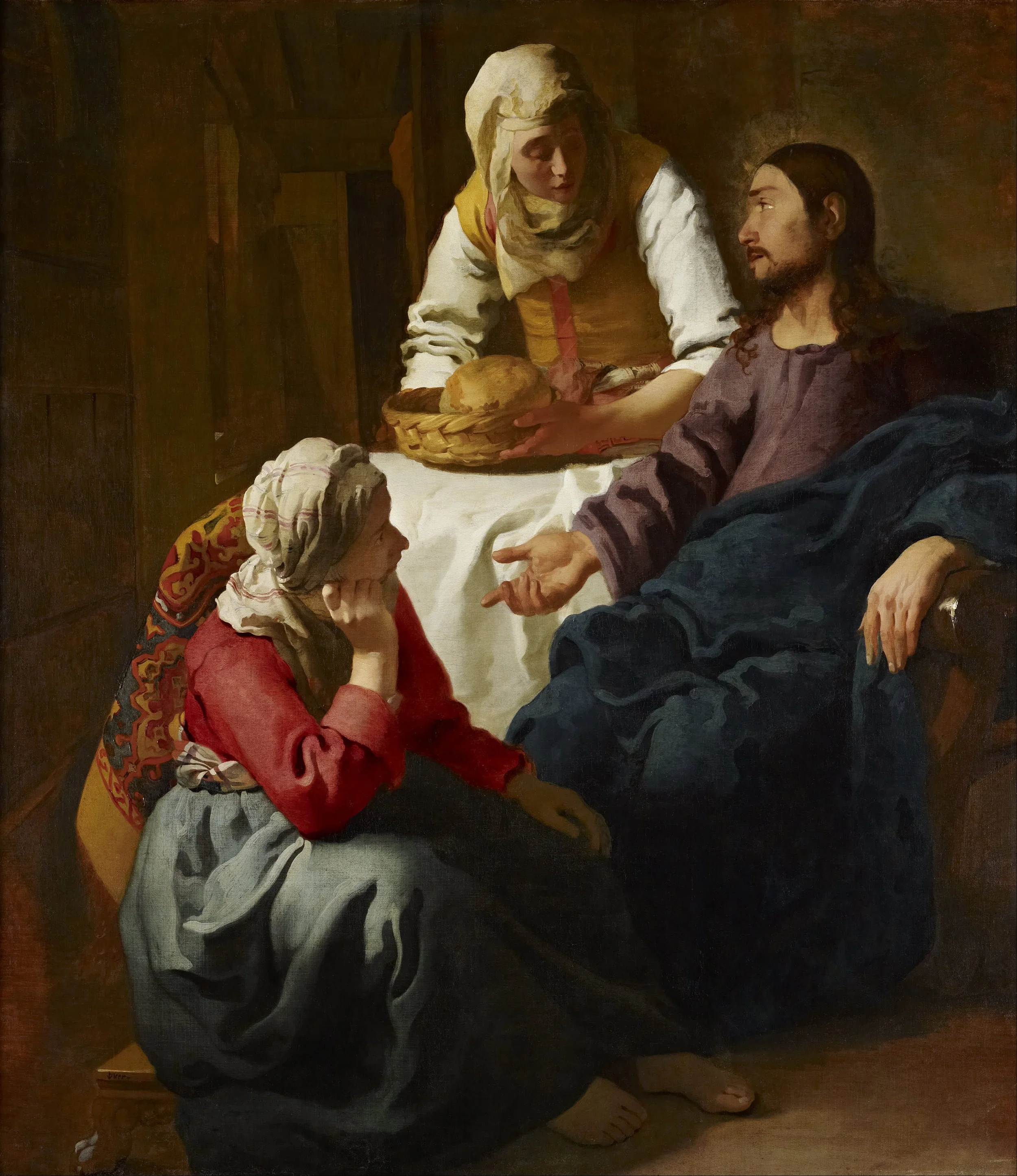
In the Gospel selection we are told that Jesus entered a village where “Martha welcomed him”. We quickly get the sense of all the many things Martha does to provide hospitality and to welcome the Lord. The Gospel tells us that Martha is “burdened with much serving”. The Lord’s response to Martha tells us still more: she is “anxious and worried about many things”. I want to add here that offering hospitality and welcome is a real skill and a gift. I am sure you can think of times when you have been welcomed into someone’s home. Some people have the skill to make you feel very comfortable in their home. It shows when a host plans and takes great care over so many things to make you feel welcome. Generally speaking, as a culture we value hospitality and welcome. But we need to go deeper than the cultural value of hospitality. With the Gospel passage in mind, we need to consider what is involved with truly welcoming the Lord into one’s life. Or maybe I should say, we need to consider what is involved with truly welcoming the Lord into one’s life in the way the Lord wants to be welcomed.
I make that distinction because while the Gospel tells us that Martha welcomed Jesus, her example is clearly not the one being promoted in the Gospel and not the one the Lord favors. Rather, it is the example and the posture of Mary that is being promoted and favored. I think this lesson is challenging for many of us, maybe even most of us. It might cause some discomfort and ruffle a few feathers in our busy lives. Honestly, we need to let the Gospel challenge us in this way. So, what is it about Mary’s posture that is worth following and is favored by the Lord? The Gospel tells us that Mary “sat beside the Lord at his feet listening to him speak”. What is noteworthy here is that description of sitting at the Lord’s feet. That posture is the posture of a disciple. In fact, it was a common turn of phrase in the ancient world to describe a student. The student sits at the teacher’s feet. So, Mary is presented here in the posture of a disciple who is listening to the master and learning from him. Her posture calls to mind a lesson from the Old Testament, recorded in Deuteronomy (8:3) which says, “not by bread alone does man live, but by every word that comes forth from the mouth of the Lord.” While we know from a few places in the Bible that both Martha and Mary are close friends of Jesus and are his followers, we learn an important lesson about a tendency that can get in the way of an authentic welcoming of the Lord in our own lives as disciples. This gets at the heart of the question: Are we welcoming the Lord into our lives in the way he wants to be welcomed?
I want to be clear: in placing before us the image of Martha and the image of Mary, the Gospel is not indicating that Martha is somehow bad. The Gospel is not telling us that hospitality and welcome should not be values. But there is a risk to be like Martha in that we mean to welcome the Lord, we intend to follow him, we mean to be about his business… but if we don’t recognize and follow the primacy of sitting at his feet and listening to him, we aren’t providing the welcome space for him that we think we are providing. In this context, the message is not that Martha is bad or that hospitality is bad. The message is that the better part is the example of Mary who first listens to the Lord speak and learns from him, sitting at his feet. In fact, to listen to the Lord and to be in his presence is the kind of attentive welcome that the Lord desires.
We live in a fast-paced world. Quite regularly, I hear comments and hints from people that prayer life is not what it should be. Personal prayer life may get little attention. It may be practically non-existent. We may be good about attending to prayer when it is something like the Holy Mass. The obligatory character of it sort of motivates us. But, what about personal prayer time daily? What about the sacred time spent in our daily living whereby we speak to the Lord, but also leave room to listen to the Lord? We can get wrapped up in so many things that we think are important. We can get wrapped up even in religious things that are valuable. But is that window dressing when we don’t make much time to be like Mary? We might even adopt some of that attitude of Martha that is almost comical. Not only are we busy and burdened and anxious about many things, but we even call out to the Lord, like Martha, and tell him he ought to tell the Marys around us that they should get up and get busy too! Part of what this Gospel selection does for us is it rearranges our understanding of welcome and hospitality. We likely think of welcome and hospitality as something we do, actions we take, something we give in order to provide for someone else. But in our relationship with the Lord, we are challenged to accept that the way he wants to be welcomed is by our making time and space to adopt the posture of a disciple, to sit at his feet and to listen to him. In that sense, our welcome is less about something we do or create, and more about our leaving space for him to occupy. That is the better part for a disciple.
This means we need to examine our prayer life. Attendance at Holy Mass every Sunday and holy day is a given. Or, at least it should be. But what about our personal commitment to welcoming the Lord by adopting the disciple’s posture of sitting with the Lord and listening to him? For many of us, we might respond better to a committed time of prayer. In that sense, participating with a time in our adoration chapel is a way in which you can welcome the Lord and find a real gift of calm and peace in an otherwise busy life. You won’t regret seeking information in the bulletin or calling the office to become involved with adoration. The prayerful reading and meditation on scripture is also a great act of hospitality to the Lord. In that, we listen and reflect upon God’s Word and we let Him speak to us. Other formulated prayers have a place too and they can help us, like Mary, choose the better part in the course of our day. Life in the secular realm and even our religious deeds can be too hectic. Often, we run the risk of convincing ourselves as disciples that we are doing the “work of the Lord” when we have not first spent time with the “Lord of the work”. In the temptation to be busy about many things, which can become a replacement for the welcoming posture of a disciple exhibited by Mary, hear the Lord call to you, “You are anxious and worried about many things. There is need of only one thing. Mary has chosen the better part and it will not be taken from her”.
Homily for the Sixteenth Sunday in Ordinary Time by Fr. Stephen Hamilton.
Reading 1 Genesis 18:1-10a
Responsorial Psalm Psalm 15:2-3, 3-4, 5
Reading 2 Colossians 1:24-28
Alleluia Cf. Luke 8:15
Gospel Luke 10:38-42
Read MoreST. MONICA CATHOLIC CHURCH
2001 N. Western Avenue, Edmond, OK 73012-3447
Office hours: Monday-Friday - 9:00 a.m. to 5:00 p.m.
Telephone (405) 359-2700
Rev. Stephen V. Hamilton, S.T.L., Pastor